
Why So Many of Us Are Searching for Natural Anxiety Relief
Anxiety is no longer a niche concern in the UK — it is close to a national norm. According to the Mental Health Foundation, nearly three-quarters of UK adults (73%) said they had felt anxious at least sometimes in the previous two weeks, with one in five feeling anxious most or all of the time. Office for National Statistics data shows that 37.1% of women and 29.9% of men reported high levels of anxiety in 2022/23 — both figures up significantly from a decade earlier.
Against that backdrop, it makes sense that more people are looking for natural, accessible ways to take the edge off daily stress, rather than reaching exclusively for clinical intervention. Aromatherapy is one of the oldest tools available for this — but it is also one of the few wellness practices with a genuine, growing body of neuroscience behind it. This article looks at what that science actually says, where the evidence is strong, where it is still developing, and how to use aromatherapy sensibly as part of a daily routine at home.
The Real Science: How Smell Reaches the Emotional Brain
To understand why aromatherapy can influence how we feel, it helps to understand a genuinely unusual feature of human anatomy. Every other sense — sight, sound, touch, taste — is routed through the thalamus, a kind of relay station in the brain, before reaching the areas responsible for emotion. Smell is the exception. Olfactory signals travel directly from receptors in the nose to the olfactory bulb, and from there straight into the limbic system — the brain's emotional control centre, including the amygdala (which governs fear and anxiety) and the hippocampus (which governs memory).
This is not a metaphor or a wellness talking point — it is established neuroanatomy. Because scent bypasses the usual relay system, it reaches the emotional brain faster and more directly than any other sensory input. Researchers studying this olfactory-limbic pathway have described it as uniquely positioned to influence mood, stress response, and physiological arousal almost immediately upon inhalation.
💡 In plain terms: when you smell lavender, the signal does not have to pass through the brain's usual "thinking" pathway before it can influence your emotional state. It has a more direct route than virtually any other sensory experience available to us.
What the Clinical Evidence Actually Shows
Scientific interest in aromatherapy and anxiety has grown substantially over the past two decades, and the evidence, while not without its limitations, is genuinely encouraging.
A widely cited meta-analysis of randomised controlled trials, published in ScienceDirect, reviewed studies on aromatherapy and anxiety across a range of clinical settings. It found that aromatherapy with various essential oils could reduce anxiety significantly, regardless of the underlying cause — though the authors were careful to note that more research is needed to establish standard dosages and protocols.
A separate systematic review of 76 studies involving over 6,500 patients found that more than 70% reported a positive effect on anxiety levels in groups using aromatherapy compared with control groups. Lavender was the most frequently studied oil, appearing in 42% of the randomised controlled trials reviewed, with citrus oils, rose, and bergamot also featuring prominently.
Some of the most compelling evidence comes from clinical, not wellness, settings. A review of 27 studies found that aromatherapy meaningfully reduced anxiety in patients awaiting medical procedures ranging from cardiac surgery to routine outpatient treatment — to the extent that some hospitals now use it as part of pre-procedure care. Separately, a randomised controlled trial in patients with acute coronary syndrome found that inhaling chamomile essential oil for two nights produced measurable reductions in anxiety scores and improvements in hemodynamic indices compared with a placebo group.
The Cortisol Connection: Why This Matters Physiologically
One of the more interesting threads of research looks beyond self-reported anxiety scores and measures something more objective: cortisol, the body's primary stress hormone. Several studies have found that inhaling lavender essential oil — particularly before sleep — is associated with measurably lower salivary cortisol levels. A double-blind randomised clinical trial on intranasal lavender and fennel found a notable reduction in cortisol alongside improved sleep quality after consistent use.
This matters because anxiety is not purely psychological — it has a physiological signature. Elevated cortisol is linked to a wide range of downstream effects, from disrupted sleep to impaired concentration and a heightened baseline stress response. Evidence that a simple, daily inhalation practice can measurably lower this marker, even modestly, is a meaningfully different claim from "lavender feels relaxing" — it points to an actual physiological mechanism.

Which Essential Oils Have the Strongest Evidence for Anxiety?
Not all oils are equally studied, and it is worth being honest about where the research is strongest. Based on the current body of clinical literature, the following oils have the most substantial supporting evidence:
- Lavender - By far the most extensively researched oil for anxiety and stress. Multiple RCTs link inhalation to reduced anxiety scores, lower cortisol, and improved sleep quality, particularly with consistent evening use
- Bergamot -Featured in a meaningful proportion of clinical trials reviewed in systematic analyses, often used in citrus blends for daytime anxiety support
- Chamomile -Studied specifically for its interaction with GABA receptors in the brain, which are directly involved in the body's calming response; shown to reduce anxiety in pre-procedure clinical settings
- Ylang Ylang -Research has linked inhalation to reduced blood pressure and lower salivary cortisol, making it a strong choice for evening or high-stress moments
- Rose and Clary Sage -Featured in recent reviews of aromatherapy for women's mental health, particularly during hormonally sensitive periods
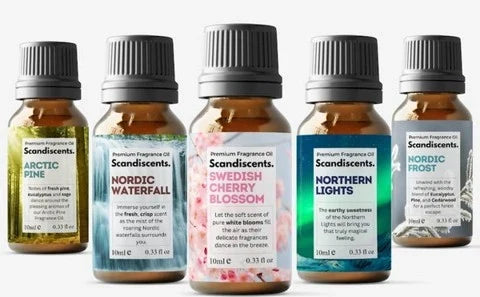
Scandiscents offers 100% pure versions of several of these, alongside thoughtfully formulated blends such as Calming — a combination of bergamot, French lavender, and ylang ylang — and Relax & Unwind, which pairs bergamot, lavender, and lemongrass for a rounded evening blend.
Why Delivery Method Matters: Why Diffusion Outperforms Other Approaches
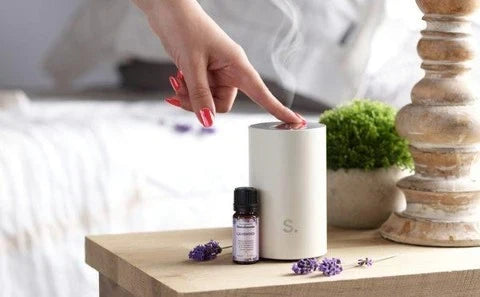
The clinical literature consistently points to inhalation — rather than topical application alone — as the most studied and most effective delivery method for anxiety-related outcomes. This is directly explained by the olfactory-limbic pathway described earlier: the therapeutic effect depends on the aromatic molecules reaching the nose and travelling that direct route to the brain's emotional centres.

Building an Evidence-Informed Routine at Home
Translating the research into a genuinely useful daily habit does not need to be complicated. A few practical principles, drawn directly from how these studies were structured, are worth following:
- Consistency matters more than intensity — most studies that found a benefit used nightly or daily inhalation over a period of weeks, not a single session
- Evening use, particularly in the 30 to 60 minutes before sleep, has the strongest evidence base, likely because it supports the body's natural cortisol decline at that time of day
- Lower concentrations used regularly appear to outperform occasional, heavy use — start on the lowest diffuser setting and let the room fill gradually
- Pairing the practice with another calming behaviour — reading, a wind-down routine, dimmed lighting — appears to compound the effect, likely through simple behavioural association over time
For a structured way to build this in, the Sleepy Trio Complete Kit pairs the Halo Diffuser with three purpose-formulated evening blends, giving a ready-made starting point for anyone wanting to put this research into practice without guesswork.
Dermaglow content review
Being Honest About the Limits of the Evidence
It would be dishonest to present aromatherapy as a cure, or to suggest the evidence is beyond question. Several of the systematic reviews referenced here are explicit about their limitations: small sample sizes, inconsistent dosing across studies, a lack of standardised protocols, and in some cases an absence of robust double-blinding. The confidence level in many findings is described as "low" by the rigorous standards of evidence-based medicine, even where the direction of the effect is consistently positive.
What this means in practice is straightforward: aromatherapy is a reasonable, low-risk, evidence-informed complementary practice — not a replacement for therapy, medication, or professional support where anxiety is significant or persistent. The most credible position, reflected in the research itself, is that aromatherapy can meaningfully support day-to-day stress management alongside — not instead of — appropriate clinical care.
This article is intended for general information only and does not constitute medical advice. If you are experiencing persistent or severe anxiety, please speak to your GP or a qualified mental health professional. UK readers can also contact organisations such as Mind (0300 123 3393) or the Mental Health Foundation for further support and guidance.
Where to Start
If you are new to aromatherapy and want to explore the evidence-backed oils discussed in this article, Scandiscents' full range of essential oils and blends includes 100% pure lavender, bergamot, and ylang ylang, alongside ready-formulated calming blends. For a deeper dive into specific oils and their anxiety-related benefits, see our companion guide: Essential Oils for Anxiety.

Leave a comment
This site is protected by hCaptcha and the hCaptcha Privacy Policy and Terms of Service apply.