

Open-plan living is lovely until you try to scent it. A small diffuser that works beautifully in a bedroom can vanish in a kitchen-diner, because the scent spreads thin across a big space, drifts through doorways and is pulled away by air currents. Here is how to choose a diffuser that genuinely copes with a large room, how to place it, and how to get a steady, balanced scent without overdoing it.

Why large rooms are harder to scent
A scent has to travel, and in an open-plan space it has more room to thin out. High ceilings, open doorways, ventilation and the simple volume of air all dilute it. Some people also stop noticing a scent after a while, so they turn the diffuser up, which is why moderation matters. The aim is a gentle, even scent that you notice when you walk in, not one that fills the room.
Choosing the right type of diffuser
|
|
Water-based (ultrasonic) |
Waterless (nebulising) |
|
How it works |
Mixes oil with water and releases a mist |
Atomises pure, undiluted oil |
|
Scent in a big room |
Often softer, as the oil is diluted |
Stronger for a small amount of oil |
|
Upkeep |
Refill and clean the water tank |
No water, so nothing to clean |
|
Best for |
Small, quiet rooms |
Larger or open-plan spaces |
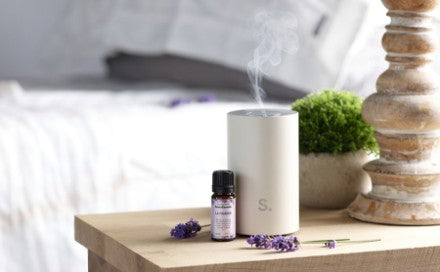
For big spaces, a waterless diffuser is the more natural choice. The Halo is designed to cover up to 80m², and our FAQ explains that avoiding dilution is what gives waterless diffusers their stronger scent, with no standing water left in the machine. Coverage figures are always a manufacturer's claim, and real results depend on ceiling height and airflow, so treat 80m² as the upper end and use the settings to tune it.
How a waterless diffuser compares with other ways to scent a room
|
|
How the scent spreads |
Upkeep |
Worth knowing |
|
Candle |
Mostly close to the flame, strongest within a few feet |
Trimming, replacing, never leaving unattended |
Naked flame, and burning produces soot and smoke |
|
Reed diffuser |
Slow and gentle, with no control over strength |
Flip the reeds, replace the oil |
Better for small spaces than open-plan rooms |
|
Plug-in air freshener |
Steady but fixed, near the socket |
Replace the refill |
Fixed scent, and tied to a socket |
|
Water-based (ultrasonic) diffuser |
Soft mist, with the oil diluted in water |
Refill and clean the tank |
Often a lighter scent, so better in smaller rooms |
|
Waterless diffuser |
Fine mist of pure, undiluted oil, with adjustable strength |
None beyond swapping the bottle |
A stronger scent for a little oil, so start low |
None of these is wrong. A candle is lovely for an evening, and a reed diffuser is a simple choice for a hallway. The difference in a big space is control: you cannot turn a reed diffuser up when a room feels thin, and you cannot set a candle to switch itself off.
What to look for in a diffuser for a large space
● Adjustable intensity: the Halo has low, medium and high settings, so you can raise the scent for a big room and lower it for a small one.
● Timers: four timer settings, from one to four hours, mean you can run it while you are home and let it switch itself off.
● Cordless power: it is rechargeable, with a battery rated for up to 72 hours, so you can place it where the scent works best instead of beside a socket.
● Simple oil changes: the 10ml bottle screws directly on, so swapping scents takes about five seconds.
● Both oil types: it works with essential oils and fragrance oils, so you can choose by mood rather than by machine.

The limits of any coverage figure
We would rather be straight with you than promise a perfect room. A figure such as 80m² describes the space a diffuser is designed to serve, but how far and how evenly the scent actually travels depends on several things:
● Layout: a single open space lets scent flow freely, while alcoves, half walls and doors create pockets where it lingers or fades.
● Airflow: open windows, extractor fans, air conditioning and even people walking through all move scent around.
● Ceiling height: the same floor area holds far more air under a double-height ceiling, so the scent thins out.
● The scent itself: some oils are naturally bolder than others, and fresh, light scents tend to carry differently from rich, warm ones.
● Personal perception: noses differ, and you notice a scent less the longer you are in it. A guest who walks in will often smell it more strongly than you do.
The practical answer is to treat the coverage figure as a starting point. Begin on a middle setting, give it ten minutes, then adjust the setting, the position or the timer until it feels right in your own home.
Where to put it
● Go central. Place it near the middle of the space, not tucked into a corner.
● Aim for table height. A coffee table, sideboard or kitchen worktop works better than the floor.
● Avoid draughts. Keep it away from open windows, extractor fans and vents, which pull scent away before it spreads.
● Think in zones. If your space is much bigger than 80m², or split across rooms or floors, use more than one diffuser. Because the Halo is cordless, you can also move it from kitchen to lounge as the day changes.
● Use the middle setting first. Raise it only if you cannot notice the scent after ten minutes of walking around.
Common mistakes in big rooms
● Turning it to maximum straight away. Your nose adapts quickly, so a scent that fades from your attention is not necessarily gone. Ask someone who has just walked in.
● Hiding it in a corner. A diffuser behind a sofa or beside a radiator wastes most of its output.
● Placing it by the kitchen extractor. Cooking smells and fans work against any scent you are trying to build.
● Running it all day. Sessions with breaks give a fresher result and use less oil.
● Choosing a heavy scent. Rich, sweet fragrances can feel overpowering across a big space. Lighter, cleaner scents travel better.
If you cook often, try switching the diffuser on about half an hour before guests arrive, once the extractor is off and the windows are closed. The scent has time to settle and the room feels welcoming from the first minute.
Choosing a scent for a shared space
A living area is shared, so pick something broadly liked. Fresh, clean scents such as Fresh Linen, Ocean Breeze or Baby Powder suit a space used by the whole household, and our Hotel Range bundle is designed to give a boutique-hotel feel. For the colder months, the Scandinavian bundle brings a woodland-and-frost mood. If you want an energising scent for daytime, Lemon is a bright option.
Safety and comfort in a shared space
Oils are potent, so even in a large room it helps to diffuse in sessions rather than all day. The Tisserand Institute advises against continuous diffusing and suggests some fresh air exchange. In a shared home, think about everyone: check with your GP or pharmacist if anyone is pregnant or asthmatic, and be careful around children. If you have pets, make sure they can always leave the room, as cats and birds are especially sensitive.
Your questions answered
Is 80m² realistic for an open-plan room?
It is the manufacturer's coverage figure for the Halo, and an upper limit rather than a promise. In a room with high ceilings, lots of airflow or several doors, start on a higher setting and place it centrally.
Do I need more than one diffuser?
For a single open-plan space within the quoted range, one usually does the job. For very large homes, or separate zones on different floors, a second diffuser gives a more even scent.
Should I use an essential oil or a fragrance oil?
Choose by purpose. Essential oils are plant extracts, often chosen for how they make you feel. Fragrance oils are formulated for scent alone, and give you smells such as clean linen that no plant can produce.
How long will a bottle last in a big room?
Scandiscents quotes up to 110 hours from a 10ml bottle. Running a higher setting for longer in a large space will use oil faster, so using timers is the easiest way to stretch a bottle.
How often do I need to charge it?
The Halo is rated for up to 72 hours of battery life. How long it lasts in practice depends on the settings you choose, so charge it when you notice the light dimming or the scent weakening.
The bottom line
The best diffuser for a large space is one that can deliver enough scent without diluting it, lets you control the strength and moves with you. Place it centrally, start in the middle, and let the timer do the work.
Ready to scent your open-plan space? Meet the Halo Home Diffuser, then pick your first bottle from the full oil range or try the Best Sellers bundle.

Leave a comment
This site is protected by hCaptcha and the hCaptcha Privacy Policy and Terms of Service apply.