
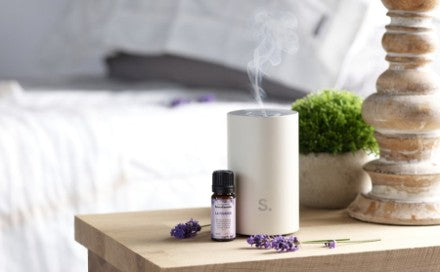
Search for sleep oils and you will be told that almost everything works. It doesn't, and the honest answer is more useful than the hype. A handful of oils have genuine research behind them, most of that research is small and early, and none of them will fix a sleep problem on their own. Here is what the evidence says about lavender, bergamot and cedarwood, how they come together in a blend, how to use them in a normal evening, and when an oil is not the answer.

First, what an oil can and cannot do
An essential oil is not a sedative. What it can do is help your body and brain shift gear, and the scent itself becomes a cue that the day is over. Most of the research measures how people say they slept, in fairly small groups, so it is best read as promising rather than proven.
That is why oils work best as part of a routine, not instead of one. The NHS advice is simple: keep regular bed and wake times, switch off screens for about an hour before bed, make the bedroom quiet, dark and cool, and if you are still awake after about 20 minutes, get up and do something relaxing until you feel sleepy. Add a scent to that and you have a ritual worth keeping.
Lavender: the best-studied oil
Lavender has the longest research trail. A review by Fismer and Pilkington in the European Journal of Integrative Medicine looked at eight controlled human trials and concluded that inhaling lavender may give a small to moderate benefit for sleep. The authors were careful to call the results promising but to be viewed with caution, mainly because most trials were small. Its calming scent comes largely from linalool and linalyl acetate, which is why it is the usual starting point. Our Lavender Essential Oil is a 100% pure essential oil, and that matters: a lavender-scented fragrance oil may smell similar, but it is not the plant chemistry the studies are based on.
Bergamot and cedarwood: promising supporting acts
The Sleep Foundation's review of the research notes that bergamot is harder to assess because it is usually studied in blends. One reported study of a bergamot and sandalwood blend found better sleep quality in 64% of healthy women. Cedarwood contains cedrol, a compound linked to sedative effects, and the same review suggests using it for at least 20 nights before deciding whether it suits you.
This is one reason blends are popular. Relax & Unwind combines bergamot, lavender and lemongrass, while Sweet Dreams pairs cedarwood and lavender with lemon verbena and ylang ylang. If you like the idea of bergamot on its own, try Bergamot Essential Oil.
Calming: bergamot, lavender and ylang ylang in one bottle
If you would rather not choose between oils, our Calming blend brings together bergamot, French lavender and ylang ylang, all 100% pure essential oils. It pairs the two oils discussed above with ylang ylang, a soft, floral note traditionally used for relaxation. One thing to be clear about: the research in this post looks at the individual oils, not this particular blend, so think of Calming as a lovely, convenient way to enjoy them together rather than a proven sleep aid. One customer review says it is so soothing that they love it as they drift off to sleep.

How to use sleep oils in the evening
● In the Halo: screw a 10ml bottle straight into your Halo waterless diffuser, choose the lowest setting and use a timer. There is no water to add and nothing to clean.
● Start early: switch it on 30 to 60 minutes before bed while you wash, read or tidy, then let the timer end it. Safety guidance from the Tisserand Institute advises against diffusing continuously.
● Mind the distance: one customer review of our Lavender notes the scent can feel strong when the diffuser sits too close to the bed, so a shelf or dresser across the room works well.
● Pillow or bath: a drop or two on a tissue near your pillow works, or a few drops in an unscented bath oil. Never add neat oil to bath water, and dilute in a carrier oil before it touches skin.
Safety first
Essential oils are potent. If you are pregnant, have asthma, take regular medication or are diffusing around children, check with your GP or pharmacist first. Pets need particular care: vet guidance lists lavender among the oils of concern for cats, so make sure animals can always leave the room and never shut them in with a running diffuser. If poor sleep lasts for weeks, speak to your GP, because an oil is a comfort, not a treatment.
Your questions answered
Which oil should I try first?
Lavender, because it has the most research behind it. If you would like several calming oils in one bottle, try our Calming blend, or Sweet Dreams if you prefer something with a woodier note.
Should I choose an essential oil or a fragrance oil for sleep?
For an aromatherapy routine, choose an essential oil, as it carries the natural compounds studied for sleep. A fragrance oil is made for scent alone, so it suits you if you simply like the smell of a room at night.
How long before bed should I diffuse?
Thirty to sixty minutes is a sensible window. The Halo has timer settings, so you can set it and forget it rather than leaving it running.
How long until I notice a difference?
Some people feel calmer the first evening, but the Sleep Foundation suggests trying cedarwood for at least 20 nights before you judge it, and the same patience makes sense for any oil. Give it a couple of weeks as part of a steady routine.
Can I swap oils in the same diffuser?
Yes. The Halo takes standard 10ml bottles, so you can unscrew one and twist in another in seconds, and it works with both essential oils and fragrance oils.
The bottom line
Lavender, bergamot and cedarwood each have some research behind them, and the evidence is encouraging rather than conclusive. Treat oils as one part of a calm evening, alongside a consistent routine, and they are a lovely, low-effort addition.

Leave a comment
This site is protected by hCaptcha and the hCaptcha Privacy Policy and Terms of Service apply.