


The Short Answer First
An aromatherapy diffuser is a device that disperses essential or fragrance oil into the air in microscopic particles, filling a room with consistent scent and — depending on the oil — delivering genuine therapeutic benefits through inhalation. Whether you actually need one depends on what you want from your home. If you want to sleep better, manage stress more naturally, fill your home with a beautiful consistent fragrance, or simply upgrade from synthetic plug-ins and candles — then yes, you almost certainly do.
This guide explains exactly what a diffuser does, which type is worth buying, and how to get started without making expensive mistakes.
Quick Reference: Aromatherapy Diffuser Types at a Glance
|
Type |
How It Works |
Scent Strength |
Maintenance |
Best For |
|
Cold-Air Waterless |
Atomises pure oil without water or heat |
✅ Very Strong |
✅ Very Low |
Most users — premium results |
|
Ultrasonic (Water) |
Mixes oil with water, creates mist |
⚠️ Moderate |
❌ High (cleaning) |
Budget buyers, smaller rooms |
|
Reed Diffuser |
Oil absorbed through reeds, evaporates |
❌ Subtle |
✅ Very Low |
Background scent, no electricity |
|
Heat/Oil Burner |
Heat vaporises oil via candle or bulb |
⚠️ Moderate |
⚠️ Some |
Short bursts, not therapeutic |
What Does an Aromatherapy Diffuser Actually Do?
At its most basic, a diffuser breaks essential oil into microscopic particles and releases them into the air so they can be inhaled. This matters because inhalation is the most direct and effective way to receive the benefits of aromatherapy — scent molecules travel from the nose along the olfactory pathway directly to the limbic system, the brain's emotional control centre, without passing through the usual thalamic relay. This is why a specific smell can change how you feel almost instantly.
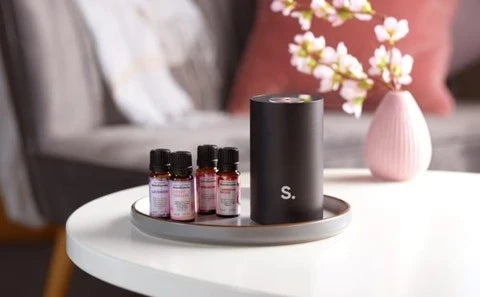
The key distinction between diffuser types is whether that process preserves or damages the oil's active compounds. Heat-based methods — oil burners, wax warmers, plug-ins — apply temperature to the oil, which breaks down some of its therapeutic molecules before they reach the air. Cold-air diffusers, like the Scandiscents Halo Home Diffuser, atomise pure oil at room temperature. Nothing is altered. The compound that makes lavender calming, or eucalyptus decongestant, reaches the air — and your nose — intact.
In short: A cold-air diffuser is the only format that delivers the full therapeutic benefit of an essential oil, not just the scent.
The Four Main Types Explained
Cold-Air (Waterless) Diffusers
The most advanced domestic format available in 2026. A small pump atomises pure oil from the bottle directly, without any water, heat, or dilution. The oil reaches the air in its complete, undiluted state, producing the strongest possible scent and the most potent therapeutic delivery. No water tank, no cleaning, no mould risk. A single 10ml bottle lasts up to 110 hours on the lowest setting.
In short: Best for most UK buyers who want genuine aromatherapy results, strong room coverage, and minimal effort.
Ultrasonic (Water-Based) Diffusers
The most widely available format. You fill a water tank, add a few drops of oil, and ultrasonic vibrations create a water-and-oil mist. The visible plume looks impressive, but the oil is diluted by the water, which weakens both the scent and the therapeutic benefit. The tank must be cleaned regularly — usually weekly — to prevent mould and limescale. Fine for a bedroom or small bathroom where subtle background scent is all you need.
In short: Suitable for budget buyers or small rooms, but a significant step down from cold-air in both scent quality and therapeutic effectiveness.
Reed Diffusers
Reeds absorb fragrance oil and evaporate it slowly into the room over days and weeks. No electricity, no maintenance beyond occasionally flipping the reeds. The scent is subtle and consistent — perfect for a bathroom, hallway, or cloakroom where you want a gentle background presence. Not appropriate for large rooms or anyone seeking meaningful aromatherapy benefits.
In short: A good secondary option for small spaces — not a replacement for an electric diffuser where therapeutic results matter.
Oil Burners and Wax Warmers
The traditional British approach — a tealight candle or electric bulb heats oil or wax from below, releasing fragrance into the room. The scent can be strong, but the heat degrades therapeutic compounds, and open-flame models carry an inherent fire risk. Not recommended as a primary home fragrance solution for modern households, particularly those with children or pets.
In short: A declining format with real safety and quality limitations compared to modern alternatives.
★★★★★ "What an amazing little machine — small but mighty. Easy to set up, just charge it up, add your essential oil and switch it on to the setting you need. The oils smell amazing. Customer service is second to none." — Jess L, Verified UK Customer, Scandiscents
Do You Actually Need One?
Here is an honest answer: it depends on what you want. If you are happy with a candle or a wax melt and simply want your home to smell pleasant, a diffuser is not essential. But if any of the following apply to you, the answer is almost certainly yes:
• You want better sleep without resorting to sleep medications — lavender in a cold-air diffuser has strong clinical evidence for improving sleep quality
• You work from home and want a natural focus tool — rosemary has well-documented cognitive benefits that are best delivered through inhalation
• You want to manage everyday stress more naturally — bergamot and chamomile have real evidence for reducing anxiety through inhalation
• You want your home to smell genuinely impressive, consistently, without having to think about it — a cold-air diffuser running on a timer does this automatically
• You are moving away from synthetic candles and plug-ins and want something cleaner and more intentional

What to Look for When Buying Your First Diffuser
• Coverage area: make sure the device suits your room size. The Scandiscents Halo covers up to 80m² — one of the highest capacities in its price class
• Oil compatibility: avoid devices locked to proprietary cartridges. The best diffusers accept any standard 10ml pure oil, giving you complete flexibility
• Noise level: for bedroom use especially, this matters. The Halo operates at 30dB — quieter than a library
• Battery vs plug-in: a rechargeable wireless device moves freely between rooms. A mains-only device is stuck where the socket is
• Oil quality: the diffuser is only as good as what you put in it. Use 100% pure oils free from carrier dilution — Scandiscents' range of 45+ oils is specifically formulated for the Halo
★★★★★ "I have had other brands but this one is by far the best. Compact enough for anywhere, the oils work a dream and the scent is amazing." — Sarah S, Verified UK Customer, Scandiscents
How to Get Started
The most practical starting point for a UK beginner is a complete kit that includes both the diffuser and a curated set of oils, removing the guesswork from your first purchase. The Morning, Noon and Night Complete Kit pairs the Halo with Lemon, Rosemary, and Lavender — one oil for each part of the day — and is one of the most popular starting points for new customers. Alternatively, the Sleepy Trio Complete Kit is the ideal first purchase for anyone whose primary goal is better sleep.
Explore the full range of diffusers, oils, and complete kits at scandiscents.com. For a full comparison of diffuser types, read: Comparing Waterless Diffusers with Water-Based Diffusers.
Frequently Asked Questions
What is the difference between a diffuser and a humidifier?
A diffuser disperses essential or fragrance oil into the air to create scent and deliver aromatherapy benefits. A humidifier adds water vapour to the air to increase room humidity. Some ultrasonic diffusers add mild humidity as a side effect of their misting process, but this is not their primary function. A cold-air waterless diffuser like the Halo adds no humidity whatsoever — it disperses only oil.
How long should I run my diffuser for?
Most aromatherapy research uses 30 to 60-minute sessions rather than continuous all-day running. For sleep support, diffuse in the 30 to 60 minutes before bed. For focus, run it during a morning work session. The Halo's four built-in timer settings make it easy to set a fixed window and let it switch off automatically.
Can I use any essential oil in a diffuser?
No. The oil must be 100% pure and free from carrier oil dilution (coconut, almond, jojoba). Carrier-blended oils cannot atomise in a cold-air diffuser and will clog the mechanism over time. For a full guide: Can I Use Any Oil with a Waterless Diffuser?
Is an aromatherapy diffuser safe around children and pets?
Cold-air diffusers are significantly safer than candles or oil burners because there is no flame and no heat. Most pure essential oils are broadly safe in a diffused environment with normal ventilation. However, some oils are not recommended in households with cats, dogs, or birds — always check individual oil guidance and consult a vet if you are unsure. The Halo itself presents no electrical or fire risk.
How much do essential oils cost and how long do they last?
Check out our latest oil offers on 10ml bottles, which last up to 110 hours on the lowest setting — roughly 40 days of three-hours-per-day use. This makes the running cost considerably lower per hour of fragrance than candles, wax melts, or premium plug-ins.
What is the best essential oil to start with?
Lavender is the most universally recommended starting point — it has the broadest appeal, the strongest clinical evidence for wellbeing benefits, and the widest compatibility with any room or time of day. Scandiscents' Lavender Essential Oil is 100% pure Lavandula angustifolia, the specific species used in most clinical research.
This article is for general information only. Aromatherapy is a complementary wellness practice and is not a replacement for medical treatment. If you experience persistent health concerns, please speak to your GP.


Leave a comment
This site is protected by hCaptcha and the hCaptcha Privacy Policy and Terms of Service apply.