
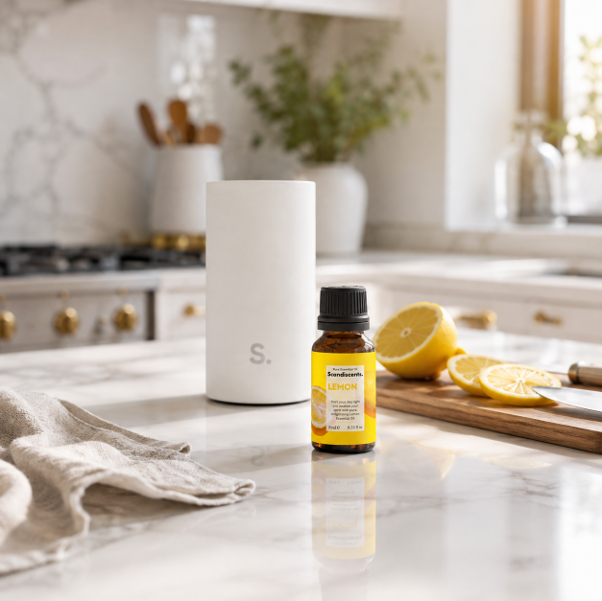
Ask us which oil people reorder the most, and lemon comes up again and again. It's the one people buy for the kitchen, then end up running in the home office, the car, wherever they need a lift. There's a reason a scent this simple has such a loyal following, and it isn't just that it smells clean. Here's what the research says about lemon oil's effect on mood and energy, how it's thought to work, and how to get the most from a bottle.

What Is Lemon Essential Oil?
Lemon essential oil is cold-pressed from the peel of Citrus limon, capturing the sharp, sunny scent of fresh lemon zest without any of the acidity of the juice. It's rich in limonene, the aromatic compound responsible for that instantly recognisable citrus smell, along with smaller amounts of other terpenes that contribute to its brightness. Unlike oils extracted from leaves or flowers, citrus peel oils like lemon are produced in huge volume relative to the fruit, which is part of why lemon tends to be one of the more affordable oils in any range. Scandiscents' Lemon Essential Oil is cold-pressed and ready to use straight in your diffuser.
The Evidence: What the Research Actually Shows
Lemon's reputation as an uplifting, energising scent isn't just marketing. It's been tested in a number of human studies looking specifically at mood, alertness and performance.
- A randomised controlled trial of first-year nursing students in Istanbul found that lemon essential oil aromatherapy significantly reduced self-reported test anxiety compared with a control group, supporting its traditional use as a calming yet energising scent before high-pressure moments.
- A review of citrus essential oils in aromatherapy, published in the journal Antioxidants, summarised evidence that citrus scents including lemon are associated with reduced stress and improved mood, attributing much of the effect to limonene's interaction with the nervous system.
- An often-cited piece of workplace research, carried out decades ago by Japanese fragrance producer Takasago, found that office workers made noticeably fewer typing errors when lemon scent was present in the room compared with an unscented control. It's worth noting this was industry-funded and predates modern trial standards, so it's best treated as a widely repeated data point rather than a rigorous clinical result, but it lines up with what more recent, better-controlled studies on citrus scents and alertness have also found.
As with most aromatherapy research, effect sizes vary and not every study is as rigorous as we'd like, but the pattern across studies is consistent: lemon is one of the more reliably “uplifting” scents in aromatherapy research, which is likely why it remains such a popular everyday oil.
How Lemon Is Thought to Work
Limonene, the dominant compound in lemon oil, is believed to stimulate the part of the brain associated with alertness and positive mood when inhaled. Unlike a stimulant such as caffeine, the effect isn't about winding the nervous system up, it's more that a bright, fresh scent seems to counter the mental fog and low mood that can creep in during a long afternoon, without the jitters or crash that come with sugar or caffeine.
Worth knowing: lemon is also one of the most versatile oils in a range, equally suited to a kitchen worktop, a home office desk, or a car diffuser, which is part of why it tends to be a repeat purchase rather than a one-off.
How to Use Lemon Essential Oil
- In a diffuser: screw a 10ml bottle of Lemon directly into your Halo waterless diffuser and run it in your home office, kitchen or living space during the day. There's no water and no mixing, just twist the bottle in and switch it on.
- On a tissue or cotton pad: a couple of drops nearby at your desk can offer a quick, portable pick-me-up between diffuser sessions.
- In cleaning routines: a few drops added to a natural surface cleaner can leave kitchen worktops smelling genuinely fresh rather than artificially perfumed.
- Blended with a carrier oil: diluted in a carrier such as sweet almond or jojoba, lemon can be used in a simple massage blend, though it should never be applied to skin that will be exposed to direct sunlight.
Safety Considerations
Like other citrus oils, cold-pressed lemon oil is phototoxic, meaning it can make skin more sensitive to UV light if applied topically before sun exposure. Avoid applying it to skin that will see daylight within 12 hours, and always dilute it properly in a carrier oil before any topical use. For diffuser use this isn't a concern at all, since the oil never touches the skin. As with any essential oil, patch test before topical use, keep it away from children and pets, and stop use if any irritation occurs.
Why It's a Bestseller
Part of lemon's popularity is simply that it's a crowd-pleaser, unlike more polarising scents such as patchouli or ylang ylang, almost nobody dislikes the smell of fresh lemon. It's also genuinely versatile: energising enough for a morning diffuser session, clean enough for a kitchen, and a natural pairing with other oils. Scandiscents blends it into Focus (with bergamot, eucalyptus and lavender) for concentration, and Immune Boost (with bergamot and eucalyptus) for an uplifting daytime blend, so if you enjoy lemon on its own, there's an easy next step once you've got through your first bottle.
Your Questions Answered
Why is Lemon a bestseller?
It comes down to versatility and broad appeal. Lemon works equally well in a kitchen, an office or a car, suits almost any other scent it's paired with, and has a genuinely uplifting effect that doesn't require any explanation, most people already associate the smell with freshness and energy, so it's an easy first purchase for anyone new to essential oils.
Can I mix Lemon with other oils in the Halo?
You can't physically blend two bottles inside the Halo itself, since each bottle screws in individually, but you can run them back to back, or choose one of the pre-blended options that already combine lemon with other oils, such as Focus or Immune Boost, which are formulated to that exact ratio for you.
Is Lemon Essential Oil or Fresh Linen Fragrance Oil better for a fresh-smelling kitchen?
It depends what you're after. Lemon Essential Oil gives a genuine citrus scent with the naturally occurring compounds studied for mood and alertness, ideal if you want a real aromatherapy benefit alongside the smell. Fresh Linen is a fragrance oil built to smell like clean laundry rather than citrus, so it's a better pick if you want your kitchen to smell like a freshly made bed rather than a lemon grove.
Does Lemon work well in the daytime vs in bedrooms?
Lemon is generally better suited to daytime spaces. Its bright, energising character is exactly what you don't want right before bed, so it's much more at home in a kitchen, office or living room during the day than on a bedside table at night, where something calmer like Lavender tends to work better.
How long does a 10ml bottle of Lemon last in the Halo?
The same as any other oil in the Halo: up to around 110 hours on the lowest setting, which works out to roughly 40 days if you diffuse for about three hours a day. Because lemon is often used during working hours rather than around the clock, many people find a bottle lasts them several weeks.
Is Lemon oil safe around pets and kids?
As with all essential oils, caution is needed. Cats in particular can be sensitive to citrus oils, so keep diffusers out of small, enclosed rooms where a pet can't leave, and always ensure good ventilation. Around children, use lower concentrations and shorter diffusing sessions, and check with a pharmacist or GP if you're at all unsure.
The Bottom Line
Lemon's popularity isn't an accident. It's a genuinely versatile, broadly liked scent with a reasonable body of human research behind its mood and alertness benefits, and it slots easily into a morning routine without needing much explanation. It won't replace a proper night's sleep or your morning coffee, but as an easy, low-effort lift during the day, it's easy to see why it keeps selling out.
Ready to give it a go? Pick up Lemon Essential Oil on its own, or try it blended in Focus, screw the bottle into your Halo Home Diffuser, and see why it's one of our most reordered oils.

Leave a comment
This site is protected by hCaptcha and the hCaptcha Privacy Policy and Terms of Service apply.