
If you've ever struggled to switch your brain off at bedtime, chances are someone has told you to try lavender. It's the go-to recommendation in every sleep hygiene article, every bedtime skincare routine, every wellness influencer's nightstand. But does it actually work, or is it just the placebo of the essential oil world? The short answer is that lavender has more research behind it than almost any other scent used for sleep, and it's genuinely worth a place in your evening routine. Here's what the evidence says, how lavender is thought to work, and the simplest way to use it tonight.

What Is Lavender Essential Oil?
Lavender oil is steam-distilled from the flowering tops of Lavandula angustifolia, most commonly grown across southern France, Bulgaria and the UK. It's one of the oldest and most extensively studied essential oils, used in aromatherapy for centuries and, more recently, in a genuinely substantial body of clinical research. Its calming, slightly herbal-floral scent comes primarily from two naturally occurring compounds, linalool and linalyl acetate, both of which have been studied for their effects on the nervous system. If you'd like to try it yourself, Scandiscents' 100% Pure Lavender Essential Oil is steam-distilled and ready to use straight in your diffuser.
The Evidence: What Sleep Research Actually Shows
Lavender is unusual among essential oils in that its effect on sleep has been tested in dozens of human clinical trials, not just anecdote or tradition.
● A 2026 systematic review and meta-analysis in Holistic Nursing Practice pooled 11 randomised controlled trials covering 628 adults and found that lavender essential oil had a consistent, positive effect on sleep quality across the studies analysed.
● A 2022 review of 20 randomised controlled trials found that lavender essential oil was associated with improved sleep quality in 14 of the 20 studies, with benefits appearing even in people who didn't yet have a diagnosed sleep disorder.
● A pilot randomised clinical trial in postmenopausal women with diagnosed insomnia found that inhaling lavender oil nightly for 29 days, alongside sleep hygiene guidance, improved self-reported sleep patterns compared with a placebo oil.
● A randomised controlled trial of 100 patients undergoing chemotherapy for blood cancers found that lavender aromatherapy before bed significantly improved sleep quality and reduced fatigue scores compared with a control group, even over just five nights.
As with most aromatherapy research, study sizes are often modest and results vary depending on how lavender is administered and for how long. But the sheer volume of human trials, across such different groups from post-surgical patients to chemotherapy patients to otherwise healthy adults, makes lavender one of the better-evidenced options for a natural sleep aid.
How Lavender Is Thought to Work
Researchers believe linalool and linalyl acetate interact with the GABA neurotransmitter system, the same inhibitory pathway targeted by many prescription sedatives, which may explain lavender's calming effect on the nervous system. Inhaling the scent appears to lower heart rate and reduce the physiological markers of stress that typically keep the brain in an alert, wakeful state, making it easier to drift into sleep once the body is given the chance to settle.
Worth knowing: lavender's effect isn't just about liking the smell. Several trials measured objective outcomes such as total sleep time and sleep efficiency using sleep diaries and monitors, not just how relaxed participants said they felt.
How to Use Lavender for Sleep
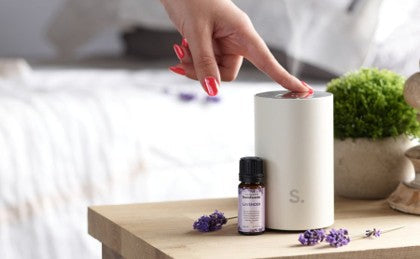
● In a diffuser: screw a 10ml bottle of Lavender directly into your Halo waterless diffuser and run it for the thirty to sixty minutes before bed. There's no water and nothing to clean, just twist the bottle in and let it fill the room while you get ready for sleep.
● On your pillow or nightstand: a drop or two on a tissue tucked near your pillow can be enough for a lighter, more localised scent.
● In the bath: a few drops in an unscented bath oil or dispersant can turn a bedtime bath into part of the wind-down ritual (never add neat oil directly to bath water).
● Blended with a carrier oil: diluted in a carrier such as sweet almond or jojoba, lavender can be massaged into pulse points like the wrists or temples before bed.

Safety Considerations
Lavender is one of the gentler essential oils and is generally well tolerated, but it should still be patch tested before any topical use, kept away from children and pets, and used in moderation. Very rarely, lavender has been associated with skin sensitisation in people with existing sensitivities, so discontinue use if any irritation appears. As with any essential oil, it's a complementary aid for everyday sleep difficulties rather than a treatment for diagnosed insomnia or a substitute for medical advice, so anyone with a persistent sleep disorder should speak to a GP.
Why It Outperforms Most Other “Sleep” Scents
Plenty of scents are marketed for sleep, but few have lavender's depth of research behind them. That's part of why Scandiscents blends it into Sweet Dreams (with cedarwood, lemon verbena and ylang ylang) and Relax & Unwind (with bergamot and lemongrass), so if pure lavender's herbal scent isn't quite your favourite, there's still a way to get its benefit in a blend that might suit your taste better.
Your Questions Answered
How long before bed should I run my diffuser?
Thirty to sixty minutes before you plan to sleep tends to work best, long enough for the scent to fill the room and for you to notice a shift in mood, without needing it running all night. Many people run it while doing their evening routine, brushing teeth, reading, getting into bed, and switch it off just before lights out.
Can I leave the Halo diffuser running all night?
Yes, the Halo is designed to run safely for extended periods and has built-in timer settings, so if you prefer a low level of scent throughout the night rather than a burst before bed, that's entirely fine. A single 10ml bottle lasts up to around 110 hours on the lowest setting, so even nightly use adds up to weeks of use per bottle.
Does Lavender work better as an essential oil or fragrance oil for sleep?
For a genuine aromatherapy effect, choose the essential oil. Lavender essential oil carries the naturally occurring linalool and linalyl acetate that the sleep research is actually based on. A lavender-scented fragrance oil might smell similar, but as a synthetically formulated scent it isn't expected to carry the same therapeutic compounds, so it's a better fit if you just want the smell rather than the studied effect.
Can children use Lavender in a diffuser?
Lavender is one of the gentler oils and is commonly used in family settings, but essential oils should always be used cautiously around children, at a lower concentration and for shorter periods, with the diffuser kept out of reach. If in doubt, check with a pharmacist, health visitor or GP before introducing any essential oil into a child's bedroom.
How much Lavender oil should I use for a bedroom-sized room?
The Halo is designed to cover up to 80m², so for an average bedroom you don't need to use more than the lowest or medium setting to notice the scent. There's no need to add extra drops or run it on the highest setting, a light, consistent scent works better for sleep than an overpowering one.
What pairs well with Lavender for an evening routine?
Lavender blends naturally with other calming oils. Scandiscents combines it with bergamot and lemongrass in Relax & Unwind, and with cedarwood, lemon verbena and ylang ylang in Sweet Dreams, both designed specifically for the hour before bed.
The Bottom Line
Lavender's reputation as a sleep aid isn't just wellness folklore, it's backed by a genuinely large body of human research spanning postmenopausal women, chemotherapy patients and healthy adults alike. It won't cure a diagnosed sleep disorder, but as a simple, low-effort addition to a bedtime routine, few scents have this much science behind them.
Ready to try it tonight? Pick up 100% Pure Lavender Essential Oil or a ready-blended sleep oil like Sweet Dreams, screw the bottle into your Halo Home Diffuser, and let your evening routine do the rest.

Leave a comment
This site is protected by hCaptcha and the hCaptcha Privacy Policy and Terms of Service apply.